
Thu Oct 22
Sash window ironmongery is the hardware that lets a timber sash work properly, close securely and look correct. On heritage and conservation projects, the hardware schedule is rarely an afterthought. Get it wrong and a conservation officer will reject the submission. Get it right and it blends into the building as if it had always been there.
In this guide, we cover the key components, finish options and security considerations, along with how we approach ironmongery specification on listed and period properties.
The core components of sash window ironmongery
Sash lifts
Sash lifts are the recessed or projecting fittings you use to raise the bottom sash. They usually sit centrally on the bottom rail and come in a range of profiles, from simple reeded or plain bar lifts through to ornate cast designs for Georgian and Victorian properties. Handle widths commonly run from 102 mm to 140 mm end-to-end, with fixing centres to suit.
Sash fasteners
The fastener, or catch, holds the two meeting rails together when the window is shut. These are the main patterns you’ll find on traditional sash windows:
- Fitch fastener: the most common period style, where a rotating cam fits over a keep on the opposing rail
- Brighton fastener: a lever-action design dating back to the nineteenth century
- Reeded knob fastener: a knob-turn mechanism with a reeded barrel, seen on many Victorian properties
- Claw fastener: a decorative pattern with a projecting claw detail
- Straight arm fastener: a simpler flat-arm pattern for less ornate joinery
Where security calls for it, all the main patterns come in lockable versions, with no compromise on the period look.
Pulleys
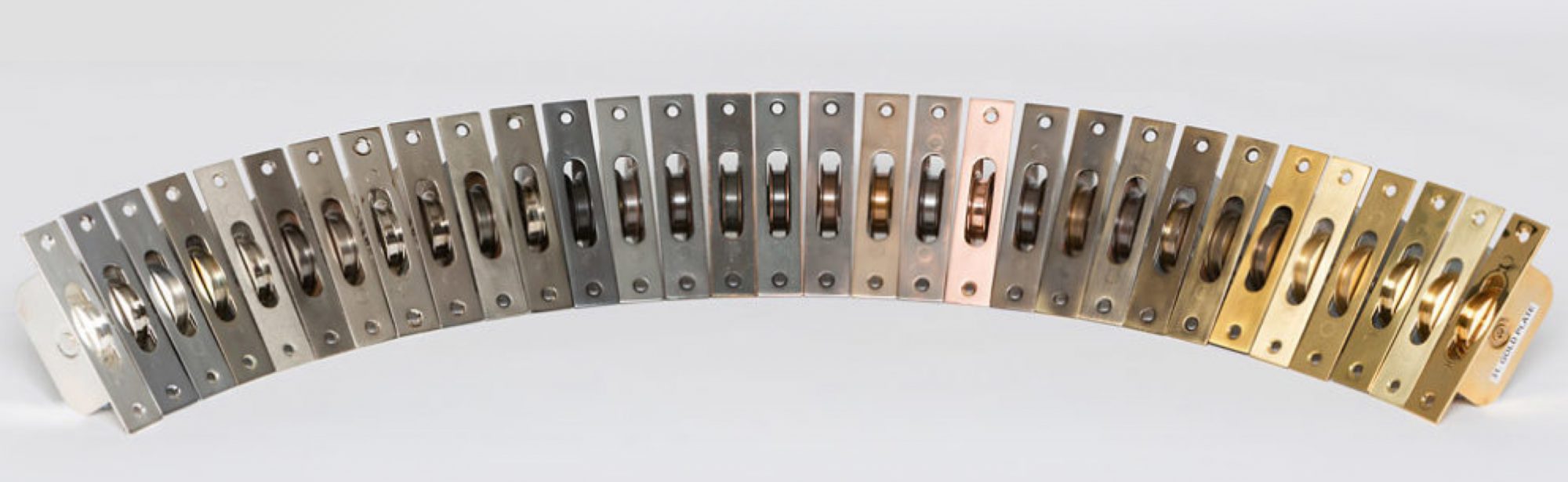
Traditional cord-hung sash windows use axle pulleys mortised into the pulley stile. These carry the sash cords that the counterbalance weights run on. Wheel diameters are typically 42 mm, 51 mm or 64 mm, and the right size depends on the pulley stile rebate depth and the weight of the sashes. Go too small and you’ll get more cord wear, and the sash can bind. Go too big and the pulley may not sit flush.
Sash cords and chains
Traditional laid hemp or twisted flax cord is the authentic choice for counterbalance sash windows, and it’s what conservation officers prefer on listed buildings. Galvanised or stainless steel chains last longer. They’re used on heavier sashes and on high-traffic or institutional installations where frequent maintenance isn’t practical.
Security restrictors and sash stops
Sash stops are small bolts or key-operated pins that limit how far the bottom sash can travel. They’re standard on any security-enhanced sash window, letting you hold the window in a ventilation position while stopping anyone from pushing the sash up further from outside.
Finish options and conservation officer requirements
Finish is one of the most closely scrutinised parts of a heritage ironmongery schedule. On a listed building, the planning condition will usually require like-for-like replacement, or a finish that’s clearly appropriate to the period.
Our standard ironmongery collection comes in:
- Polished brass: suits Georgian, Regency and early Victorian properties
- Satin chrome: suits Edwardian and inter-war properties
- Polished chrome: suits contemporary and post-war refurbishments
More finishes are available to special order, including polished nickel, satin nickel, antique brass and bespoke patinated options. If a project needs an exact match to surviving original hardware, we can work from photographs, physical samples or the surviving fittings themselves to source or replicate the right pattern and finish. That matters most on Grade I and Grade II* listed buildings, where planning conditions require exact replication.
PAS 24 and security specification
PAS 24:2022 is the British standard for enhanced security performance in windows and doors. Under Approved Document Q, PAS 24 compliance is a legal requirement for windows in new dwellings, including conversions and material change of use. It isn’t a statutory requirement for replacement windows in existing residential and commercial properties. Even so, social housing procurement frameworks, insurance underwriters and Secured by Design schemes often ask for it.
On heritage and listed buildings, the challenge is reaching PAS 24-level security without spoiling the look of the ironmongery. In practice, that means specifying:
- Security-enhanced fasteners with reinforced keeps and anti-manipulation profiles, finished to match the period hardware
- Anti-lift blocks or chimney blocks at the top of the bottom sash
- Keyed sash stops that limit bottom-sash travel and give a tested ventilation position
- Toughened or laminated glazing in the sash itself, tested as part of the complete window system
How TRC Contracts approaches ironmongery specification
Our ironmongery range covers pulleys, fasteners, sash lifts, sash stops and handles. Standard finishes are polished brass, polished chrome and satin chrome, with a wider palette to special order.
On restoration projects, we look at any surviving original hardware during the survey and advise whether refurbishment, like-for-like replacement or sympathetic substitution is the right way forward. If conservation officers want documentary evidence of historical precedent for a particular pattern or finish, our team can support you through the pre-application process.
For new sash window installations on heritage properties, including our Heritage Box Sash and vacuum glazed ranges, we confirm the ironmongery schedule at tender stage as part of the full specification package. That way, there’s nothing left open to interpretation on site.
Explore our architectural ironmongery service, or use our product selector to find the right window and hardware combination for your project.